$20 vs $200 Trail Running Shoes: Are Expensive Running Shoes Really Worth It?

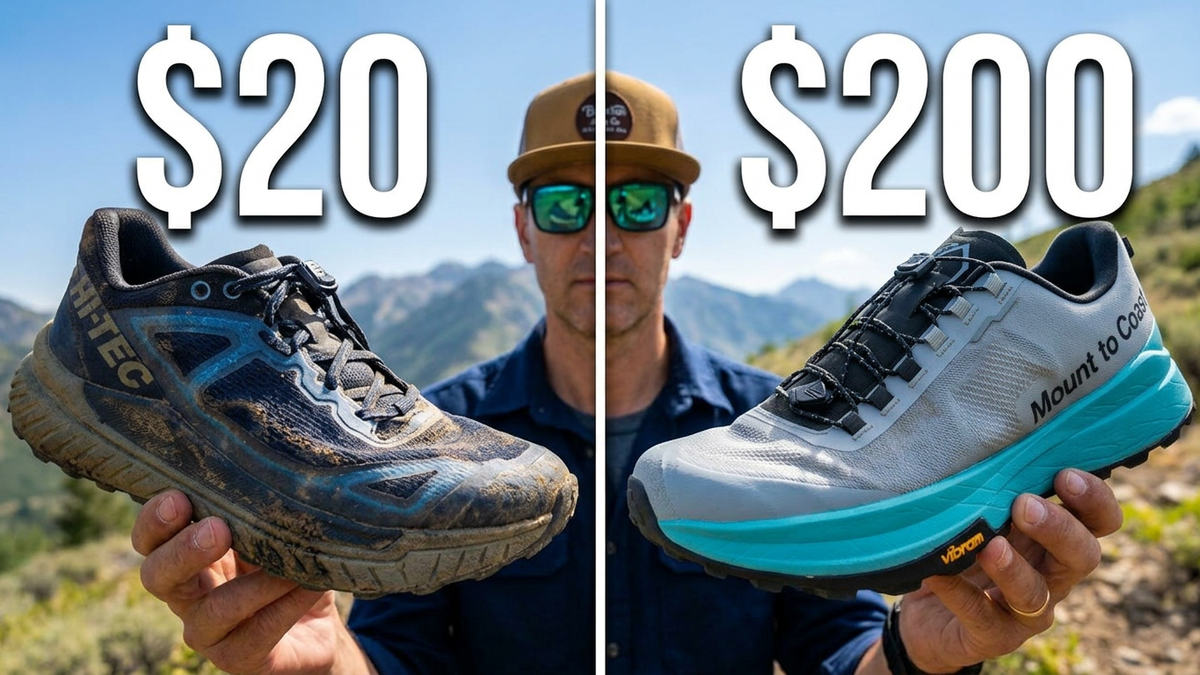
Do you really need to spend $200 on a pair of trail running shoes?
That’s the question I wanted to answer. Running shoes have gotten increasingly expensive. It’s not unusual to see premium trail running shoes selling for $150, $180, $200 or even more. At the same time, there are budget running shoes available for a fraction of that price.
So what happens when you put a $20 pair of trail running shoes head-to-head against a $200 pair?
Is the $200 shoe dramatically better?
Does the expensive shoe actually make you a better runner?
Or are you paying for technology you may not actually need?
I decided to find out.
Watch the Full $20 vs $200 Running Shoe Test
Rather than just talking about the differences, I put the shoes to the test.
Watch the full video here:
$20 vs $200 Trail Running Shoes — Are Expensive Shoes REALLY Worth It?
In the video, I compare the experience of running in shoes at completely different price points and look at the things that actually matter when you're out on the trail.
Why Are Running Shoes So Expensive?
Walk into a running store and you'll quickly notice that running shoes aren't all priced the same.
You can find inexpensive shoes around $20–$50, mainstream daily trainers around $100–$160, and premium performance shoes pushing well beyond $200.
According to RunRepeat's running-shoe statistics, the average MSRP for a running shoe was about $132.90 in 2023, while only 7.2% of running shoes had an MSRP of $200 or more.
So a $200 running shoe isn't necessarily the norm. It's the premium end of the market.
But what exactly are you paying for?
What Do You Get When You Spend More?
Generally, higher-priced running shoes can incorporate more advanced materials and technology.
That can include:
- More advanced foam compounds
- Higher-quality or more specialized uppers
- Improved cushioning
- More sophisticated outsole rubber
- Better traction
- Carbon-fiber plates or other performance components
- Lower weight
- More specialized designs
Recent shoe testing from RunRepeat shows that some premium shoes use advanced foams and outsole compounds that can provide measurable differences in areas such as energy return, cushioning and traction.
But here's the important part:
More expensive doesn't automatically mean better for every runner.
Does a $200 Shoe Make You a Better Runner?
This is where things get interesting.
A more expensive shoe may provide features that are valuable to a particular runner. But if those features don't matter to the way you run, you may not get much additional value from them.
Think about it this way.
If you're running three miles a couple of times a week, do you need the same technology as someone training for a marathon or ultramarathon?
Probably not.
And even if you run serious mileage, the most expensive shoe isn't necessarily the right shoe for you.
Fit, comfort, terrain, durability and how the shoe feels under your feet can matter just as much as the price tag.
A previous analysis from RunRepeat looked at more than 134,000 user reviews across 391 running shoes and found no positive relationship between list price and user ratings.
That doesn't mean cheap running shoes are automatically better.
It means price alone isn't a reliable way to determine whether a running shoe is right for you.
The $20 Running Shoe Experiment
That's why I wanted to take this out of the spreadsheet and onto the trail.
It's easy to look at specifications on a website and assume the more expensive shoe will win.
But running is different.
You actually have to put the shoes on your feet.
You have to run in them.
You have to climb.
You have to descend.
You have to deal with rocks, dirt, uneven terrain and whatever else the trail decides to throw at you.
And that's where the differences between inexpensive and premium running shoes can become much more obvious.
Or sometimes...
not as obvious as you'd expect.
What Should You Look For in a Trail Running Shoe?
If you're shopping for trail running shoes, I wouldn't start with the price.
I'd start with the trail.
1. Fit
A $200 shoe that doesn't fit your foot is still a bad running shoe.
Your heel should feel secure, your toes should have enough room, and your foot shouldn't be sliding around inside the shoe.
2. Cushioning
How much cushioning you need depends on your running style, mileage and terrain.
Some runners love a plush, highly cushioned shoe.
Others prefer a more responsive and connected feel with the trail.
3. Traction
For trail running, traction can be one of the most important characteristics of a shoe.
If you're running loose dirt, mud, rocks or steep terrain, outsole rubber and lug design can make a significant difference.
4. Durability
A cheap shoe isn't necessarily a good deal if you have to replace it twice as often.
The better question isn't always:
"How much does this shoe cost?"
It can also be:
"How much does each mile cost me?"
5. Comfort
This one sounds obvious, but it's easy to overlook when we get caught up in technology.
The best running shoe for you is ultimately one you actually enjoy running in.
Is a $20 Running Shoe Worth Buying?
That's the real question.
And the answer isn't as simple as cheap = bad or expensive = good.
There are inexpensive running shoes that can work perfectly well for certain runners and certain types of running.
There are also legitimate reasons to spend more.
The trick is figuring out what you're actually getting for the extra money.
Current running-shoe testing shows that premium shoes can offer measurable advantages in materials, cushioning, energy return and traction. At the same time, affordable shoes have improved considerably and can offer strong value for runners who don't need every high-end feature.
And there's another option that often gets overlooked:
Buy last year's expensive shoe.
When a new version comes out, previous-generation shoes can receive significant discounts even though they're still perfectly capable running shoes.
That can be one of the easiest ways to get better running-shoe technology without paying full premium prices.
The Bottom Line: $20 vs $200
The biggest takeaway from this experiment isn't that everyone should buy cheap running shoes.
And it's not that everyone should spend $200.
It's that you shouldn't assume the price tag tells you everything you need to know.
A $20 shoe and a $200 shoe can be built for very different purposes.
The important question isn't:
"Which shoe costs more?"
It's:
"Which shoe gives me what I actually need?"
That's what I wanted to explore in this $20 vs $200 trail running shoe experiment.
So before you drop $200 on your next pair of running shoes, watch the test and see what happens when a $20 shoe goes up against a $200 shoe on the trail.
Because sometimes the most interesting running shoe isn't the one with the biggest price tag.
It's the one that makes you forget how much you paid for it.
Watch the Full Video
Watch "$20 vs $200 Trail Running Shoes — Are Expensive Shoes REALLY Worth It?"
More trail running, running shoe reviews, gear tests and training tips:
Visit Dan Running for more real-world running adventures, honest gear reviews and trail-running content.
Keep pounding that pavement, blazing trails, and moving mountains.