Why I Stopped Caring About My Pace on the Trails

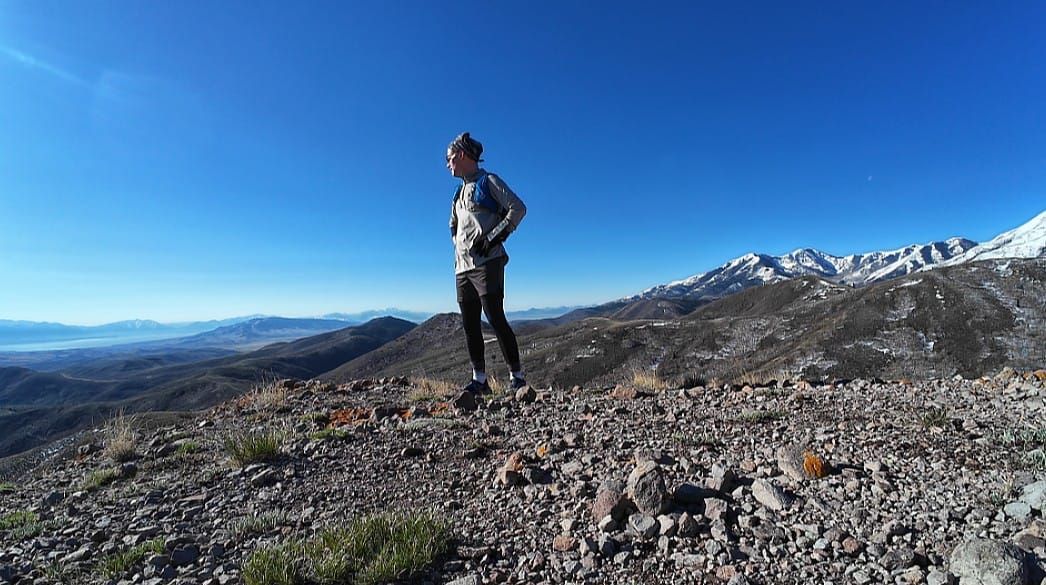
Trail running isn't always about running faster. Sometimes it's about slowing down, looking around, and remembering why you started running in the first place.
At some point, running became a numbers game.
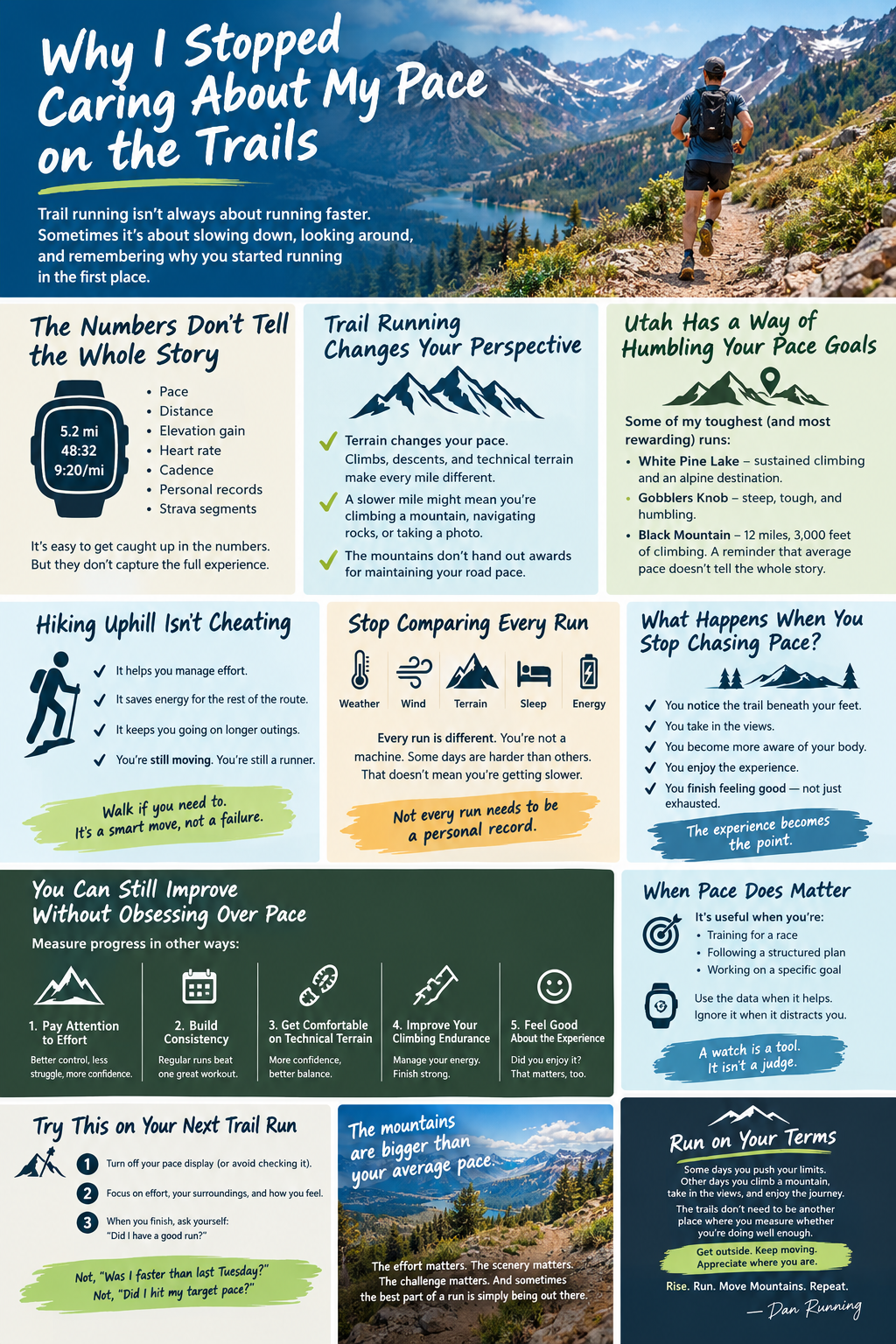
Pace. Distance. Elevation gain. Heart rate. Cadence. Personal records. Strava segments. And enough data to make you wonder whether you actually went for a run or just conducted a field experiment.
I've been guilty of it, too.
You finish a run, open your watch or running app, and immediately start evaluating the numbers. Was the pace good? Was it faster than last time? Did you make progress?
And if the numbers aren't what you hoped for, you start wondering what went wrong.

But something changes when you spend enough time running trails, particularly here in Utah.
You encounter climbs that make your usual pace irrelevant, terrain that demands your full attention, and views that are difficult to appreciate when you're staring at your watch.
Eventually, you start asking a different question.
What if the point of a trail run isn't to run faster?
What if the point is simply to get outside, challenge yourself, enjoy the experience, and make it back to the trailhead with a little more perspective than you had when you started?
That's when I started caring less about my pace.
And honestly, running became a lot more enjoyable.
Trail Running Changed How I Think About Pace
Road running makes it relatively easy to measure progress.
You can run the same route, compare your times, and see whether you're getting faster. The terrain is usually predictable, and it's easier to maintain a consistent effort.
Trail running is a different animal.
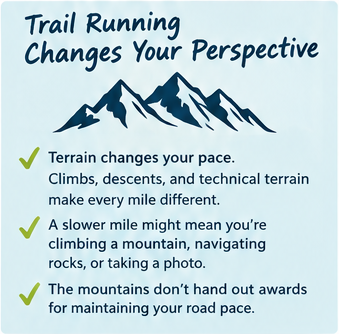
One minute you're cruising along a relatively smooth section of dirt. The next, you're climbing over rocks, navigating loose gravel, or working your way up a grade that seems to have been designed by someone who dislikes runners.
Your pace changes because the terrain changes.
A mile on a smooth trail isn't the same as a mile climbing a mountain. And a mile on a steep, rocky descent requires a different set of skills than a mile on flat ground.
Trying to compare every mile as if the conditions were identical doesn't tell the whole story.
Sometimes a slow mile means you're climbing a mountain.
Sometimes it means you're navigating technical terrain safely.
And sometimes it means you stopped to take a picture because the view was too good to ignore.
All three are perfectly acceptable reasons to have a slower mile.
The mountains don't hand out awards for maintaining your road pace on a rocky climb.
At least none that I've found.
Utah Has a Way of Humbling Your Pace Goals
Living and running in Utah makes it difficult to take pace too seriously.
The Wasatch Mountains offer incredible scenery, but they also offer plenty of opportunities to reconsider your fitness, your training plan, and possibly your life choices.
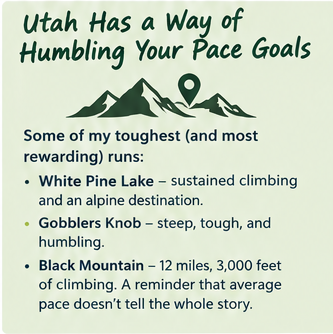
Take a route like White Pine Lake in Little Cottonwood Canyon.
It's a substantial outing with sustained climbing and an alpine destination that makes the effort worthwhile. You aren't simply running a flat path and waiting for the miles to tick by. You're gradually working your way into the mountains.
Or consider Gobblers Knob, where steep climbing and elevation make pace a poor measure of how hard you're working.
Then there's Black Mountain, one of the hardest runs I've done. With approximately 12 miles and 3,000 feet of climbing on my outing, it reminded me that the difficulty of a trail run can't be understood by looking at average pace alone.
These are the kinds of routes that teach you to pay attention to something other than your watch.
You start thinking about effort, footing, hydration, and how much climbing remains.
You learn to recognize when you should push and when you should back off.
And you discover that hiking uphill isn't a failure to run.
It's often the smartest way to get up the mountain.
If your goal is to enjoy the trail and finish safely, there's no reason to turn every climb into a competition against your watch.
The mountain will still be there when you arrive.
It isn't going anywhere.
Hiking Uphill Doesn't Make You Less of a Runner
Let's get something out of the way.
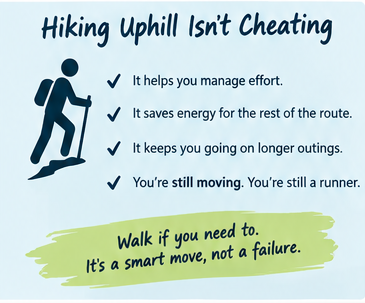
Walking uphill is not cheating.
I know that sounds obvious, but runners can be surprisingly good at turning perfectly reasonable decisions into personal disappointments.
You reach a steep climb, your pace slows, and suddenly you feel as though you should be doing more.
So you push harder than you should, burn through your energy, and spend the next mile wondering why your legs feel like they've submitted their resignation.
I've learned that there's a difference between challenging yourself and making a run unnecessarily miserable.
On steep trails, hiking can be an effective way to manage effort while continuing to make progress. It allows you to tackle demanding terrain without exhausting yourself too early.
It can also help you save energy for the rest of the route.
This matters on longer mountain outings, where the climb is only part of the challenge. You still have to navigate the terrain ahead and get back to where you started.
A trail run doesn't become less legitimate because you walked a steep section.
You're still outside. You're still moving. You're still challenging yourself.
And unless someone is standing at the top of the mountain with a stopwatch and a clipboard, I doubt anyone cares.
Even if they are, that's their problem.
The Problem With Comparing Every Run
One of the easiest ways to make running less enjoyable is to compare every outing with every other outing.
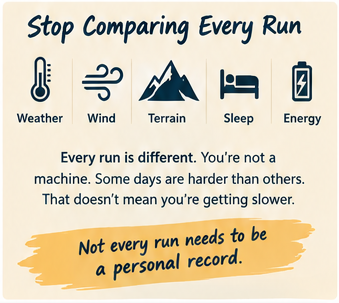
You run a familiar route and expect to match your previous time. If you don't, you assume you're getting slower.
But running conditions aren't always the same.
Temperature, wind, trail conditions, elevation, fatigue, sleep, and the amount of effort you've put into training can all influence how a run feels and how quickly you move.
Even the same trail can feel different from one day to the next.
Maybe you slept poorly.
Maybe it's warmer than usual.
Maybe your legs haven't recovered from your previous workout.
Or maybe you simply aren't having a particularly energetic day.
That doesn't automatically mean you've lost fitness.
It means you're a human being, not a piece of laboratory equipment.
This is one reason I think it's useful to stop treating every run as a test.
Some runs are meant to challenge you. Others are meant to build endurance or help you recover. And some are simply an opportunity to get outside.
Not every run needs to produce a personal record.
Not every run needs to prove something.
Sometimes the accomplishment is putting on your shoes and getting out the door.
What Happens When You Stop Chasing Pace?
For me, the biggest benefit is that I can focus more on the experience itself.
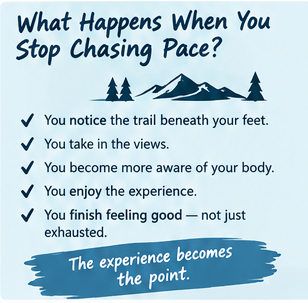
When you're constantly checking your pace, it's easy to become distracted by whether you're meeting an arbitrary target.
When you relax that expectation, you have more room to pay attention to what's happening around you.
You notice the trail beneath your feet.
You pay attention to the changing terrain.
You take in the views.
You become more aware of how your body feels and how much effort you're putting into the climb.
You might even stop for a few minutes without feeling as though you've ruined your workout.
Imagine that.
There is also something satisfying about finishing a run knowing you enjoyed the experience rather than spending the entire time worrying about your performance.
That doesn't mean I never care about pace or that I don't enjoy pushing myself.
I still appreciate a good challenge. I still want to improve. And there's nothing wrong with having goals.
I've run marathons and ultramarathons, and I understand the appeal of working toward a specific performance target.
But not every run has to serve that purpose.
I can train hard when I want to train hard and enjoy the mountains when that's what I need.
The two aren't mutually exclusive.
You Can Still Improve Without Obsessing Over Pace
Here's an important distinction: caring less about pace doesn't mean abandoning progress.
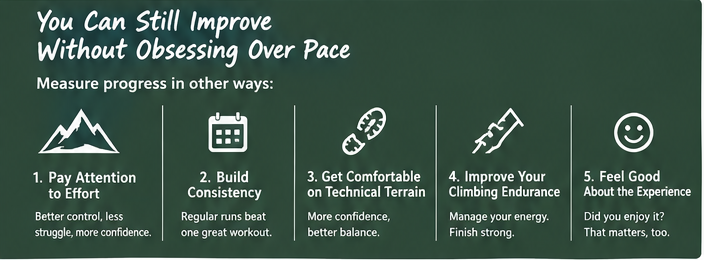
You can continue to improve your fitness, build endurance, and become a stronger trail runner without evaluating every outing by how quickly you covered the distance.
Instead of focusing exclusively on pace, consider a few other ways to measure progress.
1. Pay Attention to Effort
How hard does a particular climb feel compared with a few months ago?
If you're able to manage the same terrain with less perceived effort, that may be a sign of improving fitness.
You don't need to force a faster pace to recognize that progress.
2. Build Consistency
Getting out regularly is often more valuable than having one spectacular workout followed by several weeks of inconsistency.
Focus on developing a routine that fits your life and allows you to recover adequately.
Some days will be harder than others. That's normal.
3. Become More Comfortable on Technical Terrain
Trail running isn't just about cardiovascular fitness.
Foot placement, balance, confidence, and the ability to adapt to changing surfaces all contribute to your experience.
As you spend more time on the trails, you may find yourself moving more comfortably over terrain that once felt intimidating.
That's meaningful progress, even if your average pace doesn't change much.
4. Improve Your Climbing Endurance
Utah's trails provide plenty of opportunities to work on climbing.
Over time, you may become more comfortable sustaining an effort on longer ascents.
The goal doesn't always have to be running uphill faster. It can also be learning to manage your energy more effectively and finish strong.
5. Finish Feeling Good About the Experience
This might be the most underrated measure of all.
Did you enjoy the run?
Did you challenge yourself appropriately?
Did you finish feeling as though the outing was worthwhile?
Those questions matter, too.
And unlike a personal record, enjoying a run doesn't require you to beat a previous version of yourself.
When Pace Does Matter
I'm not suggesting that pace is useless.
There are times when paying attention to pace, effort, or other training metrics makes sense.
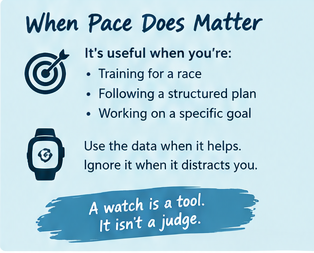
If you're preparing for a race, working through a structured training plan, or trying to improve a particular aspect of your performance, tracking your progress can be valuable.
Heart rate, perceived exertion, elevation gain, and pace can all provide useful information when interpreted in context.
The key is understanding what the numbers are telling you.
A watch is a tool. It isn't a judge.
Use the data when it helps you make better decisions. Ignore it when it distracts you from the purpose of the outing.
And remember that trail pace can vary dramatically depending on terrain and conditions.
A five-mile mountain run with significant climbing may demand much more effort than a faster five-mile run on a smooth path.
Comparing those two outings solely by average pace doesn't tell you very much.
Sometimes the most productive thing you can do is stop looking at the numbers and pay attention to how you're actually feeling.
Try This on Your Next Trail Run
If you're used to monitoring your pace constantly, try a simple experiment.
On your next easy trail run, leave your pace display off your watch or avoid checking it during the outing.
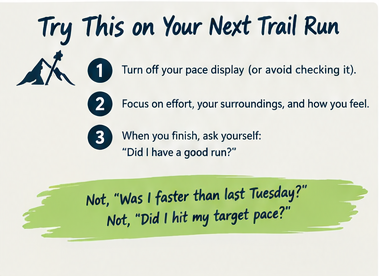
You can still record your run if you want to review the data afterward. The point isn't to reject technology. It's to remove the temptation to evaluate every mile while you're running.
Instead, focus on three things.
First, pay attention to effort.
Run at a comfortable intensity on easier terrain. When the trail gets steep, slow down or hike as needed.
Second, pay attention to your surroundings.
Notice the scenery, the trail conditions, and the changing terrain. If you reach a viewpoint worth appreciating, take a moment to enjoy it.
Third, pay attention to how you feel.
Notice whether you're enjoying yourself, whether your effort is sustainable, and whether you need to adjust your plans.
When you finish, ask yourself one question:
Did I have a good run?
Not, "Was I faster than last Tuesday?"
Not, "Did I hit my target pace?"
Just, "Did I have a good run?"
You might be surprised by how refreshing that question can be.
The Mountains Are Bigger Than Your Average Pace
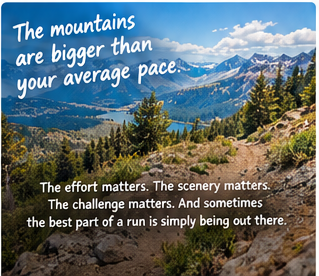
One of the things I appreciate most about trail running in Utah is the perspective it offers.
You can spend hours working your way up a mountain, navigating rocky terrain, and dealing with climbs that make the numbers on your watch look ridiculous.
Then you reach a viewpoint, look across the landscape, and realize that the pace you were worrying about a few minutes earlier doesn't seem particularly important anymore.
The experience becomes the point.
The effort matters, but so does the scenery. The challenge matters, but so does enjoying yourself along the way.
And sometimes the best part of a run is simply being out there.
I still enjoy challenging myself. I still appreciate progress. And I still think there's value in setting goals.
But I don't believe every run needs to be a race.
Some days, I want to push my limits.
Other days, I want to climb a mountain, take in the views, and enjoy the experience without turning it into another performance review.
After all, I already have enough of those in the rest of my life.
The trails don't need to become another place where I measure whether I'm doing well enough.
Sometimes it's enough to get outside, keep moving, and appreciate where you are.
And if that means your average pace looks terrible?
Well, your watch doesn't get to decide whether you had a good day.
Rise. Run. Move Mountains. Repeat.
— Dan